CLICK BELOW TO
RETURN TO
Homepage

Address:
Christopher Woodman
P.O.Box 427
2495 North Fish Creek Rd
Wilson,
Wyoming 83014
U.S.A.
&
93 Moo 12
Tawangtan, Saraphi,
Chiang Mai 50140,
Thailand
telephone:
(66) 53.817.362 Thailand
(66) 81.885.1429 "
his e-mail: christopher@homprang.com
for a bit of his prose:
www.cowpattyhammer.com
Homepage
Where We Are
Thai Herbal Medicine
Thai Traditional Massage
Herbal Steam Baths
Training Courses
Accommodations
Credentials
Calendar & FAQs
More Christopher Woodman
CLICK BELOW TO
RETURN TO
Homepage
Address:
Christopher Woodman
P.O.Box 427
2495 North Fish Creek Rd
Wilson,
Wyoming 83014
U.S.A.
&
93 Moo 12
Tawangtan, Saraphi,
Chiang Mai 50140,
Thailand
telephone:
(66) 53.817.362 Thailand
(66) 81.885.1429 "
his e-mail: christopher@homprang.com
for a bit of his prose:
www.cowpattyhammer.com
Homepage
Where We Are
Thai Herbal Medicine
Thai Traditional Massage
Herbal Steam Baths
Training Courses
Accommodations
Credentials
Calendar & FAQs
More Christopher Woodman
CLICK BELOW TO
RETURN TO
Homepage
Address:
Christopher Woodman
P.O.Box 427
2495 North Fish Creek Rd
Wilson,
Wyoming 83014
U.S.A.
&
93 Moo 12
Tawangtan, Saraphi,
Chiang Mai 50140,
Thailand
telephone:
(66) 53.817.362 Thailand
(66) 81.885.1429 "
his e-mail: christopher@homprang.com
for a bit of his prose:
www.cowpattyhammer.com
Return to Homepage
CLICK BELOW TO
RETURN TO
Homepage
Address:
Christopher Woodman
P.O.Box 427
2495 North Fish Creek Rd
Wilson,
Wyoming 83014
U.S.A.
&
93 Moo 12
Tawangtan, Saraphi,
Chiang Mai 50140,
Thailand
telephone:
(66) 53.817.362 Thailand
(66) 81.885.1429 "
his e-mail: christopher@homprang.com
for a bit of his prose:
www.cowpattyhammer.com
Return to Homepage
|
MY FRANGIPANI TREE
"So that's the girl you want, is it?"
Homprang mocks me—
"the one you write
Whispers woe
In the grieving mead
With the sweet white flowers
And the bitter seed?
"But oh mai dai, Lung Kip, mai dai!
you have no taste—no culture!
The malingering one
cannot be grown
in a pleasant home like ours,
or grace a commoner's garden."
And then the Princess Sirindhorn,
that loyal Siamese angel sister,
changes the name, rewrites
the misbegotten tree's
girl-story.
She was too grim before, you see—
Lan Tõme, the older generation groaned—
'Storm Torn Tree of Grief,'
'Sorrow's Thunder!'
Only the Wat could weather such regret,
the Princess recently announced
on government radio,
only the holy Wat could grin
at such despair,
or say, or bear it.
She knew before her gift no trusty Thai
would ever deem to have
the Lan Tõme tree at home—
it only graced the temple yard or wept
its sweet white scent
at the village crematorium.
Now its mournful shade's been
cast anew as a lovely girl that says
"Come live with me, I'm Leela Wadee—
My willowy breeze
Plays in your gentle tree!"
it's springing up all over.
Oh, I'd love to say "okay, please do,"
but water too pulls worlds apart,
I know, and air makes rain
and floods us—
the bright skinned undulating breeze
wrapped in the silk sarong
with the smiling limbs
and the black, black hair
blows up another sort of thunder.
I'm just a man who gets things done
and know that girls like this
shake down the oak and split
the hardest western beam asunder.
But the pool of Siamese meaning says
mai pen rai, "make no ado"—
that's better.
For flexibility in mind and limb
is always free just like
this groaning, gracious tree—
and wife Homprang,
now it's Leela Wadee,
is free
even with me
and let's me say
I love to grieve a storm—
and gaily with me grows it.
published in The Atlanta Review (Fall, 2009)
___________________
Homprang (‘delicate odor of the cheek’) Chaleekanha is the poet’s doctor-wife.
Mai dai means it can’t be done, that it’s never been done before and will never be done any time soon—or, for that matter, ever.
The poet is called Lung Kip in Thailand. Lung means uncle, or any man older than your father, and Kip is the poet’s childhood nickname. (‘Kip’ is much easier for a Thai to pronounce than ‘Christopher’ with its crush of syllables and consonants. His grown-up name sounds cacophonic to the Siamese ear.)
The Frangipani Tree was called Lan Tõme until it was recently renamed Leela Wadee by the King's daughter, Her Royal Highness Maha Chakri Sirindhorn, as a gift to the Thai people. Before the Princess’ intervention this most beautiful and fragrant of all trees could only be grown in a Thai wat (temple), hospital, school or palace. It was simply too risky to have a tree with a name like that around the house.
Mai pen rai means it doesn't matter--which it doesn't only because you've obviously already gone and done it.
;
.
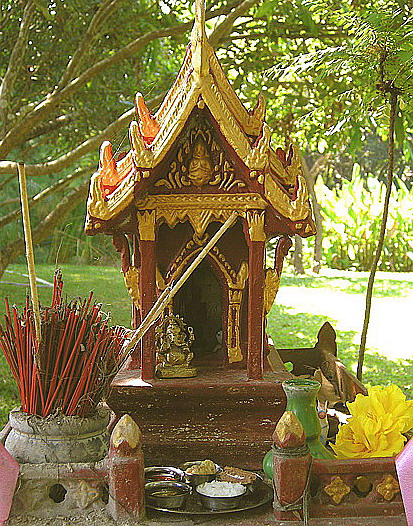
A large proportion of Thai religious beliefs and practices are Hindu rather than Buddhist in origin. This is nowhere clearer than in the Spirit Houses that are so important to every Thai family and business, including our own. Small but elaborate, these miniature palaces often contain a Shiva figure in the innermost courtyard -- if you look carefully you can see him in there just behind the beautiful shy girl looking back at you in the shadows. In many spirit houses Shiva is attended by Ganesha, the much-loved elephant-headed god who makes things happen.
Here he is at one of our houses waiting by the door.
LIKE A LOVER, LIKE A MOTHER, LIKE A MOUSE
In my father’s house
there are many mansions
just as in my village
there are many poor houses
with mansions between them—
mansions with gables and finials
and small shiny servants
kneeling by elephants,
horses, buffalo-carts and palanquins,
peacocks unfolding their fans as the girls
with big breasts fall silent, and smiling
bow brightly uncovered like bells
as they bear at the banquet
on small silver trays
tiny thimbles of whisky and water—
water-born courtyards of perfume
and smoky inhalations,
sacred waxed alcoves curtained off
with tall scented cushions
in damask and rice-green velvet,
melon-shaped with vast muslin oceans
filled out on the spirit-born breeze
like a lover, like a mother,
like a mouse—
and all of them quiet and assembled
for the rare private blink
of the god in the house,
huge, whale-still, like Herod but holy
with those wide-awake eyes and garish
like a mountain in a peep-show—
the gargantuan trunk right there,
gob-smacked, stuck right in your face—
yikes, the size of him!
So swing low, O God of Bright Presence,
Sri Power, swing O Prince of Pubescence,
O Bounteous, O Fat One—
sweet the spectacular pink Substance,
the perfect round belly, wide hips,
the radiant pure mind and broad sceptre—
oh the long, spangled prepuce,
the swooning, the monolith pout
with the make-up, the swaying unseemly
back and forth on one massive leg—
oh the bells on the ankle, the tinkling,
the trampling in time with the snout.
O Ganesha, to garnish life’s platter
with the wink of good fortune—
O Shiva, to shiver & lather us more—
O Brahma, to make it all happen,
what we want
more than anything
that happens to the gods
everyday in these mansions
up there on the humungous dwarf leg,
garlanded, stage-struck & beribboned
with incense and candles—
any morning at 8
with a glass of cool water,
and an orange on a blue plastic plate,
swaying in the mansion, up on one leg—
any morning in my father’s house,
oh heavenly mansion for the passionate,
ponderoso and intelligent,
girly-sweet god of Siam.
Chiang Mai (2020)
____________________
Despite his huge bulk, Lord Ganesha’s “vehicle,” his spiritual companion or familiar, is a tiny mouse — he's as quick, unobtrusive, omnipresent and skillful as that (the ambiguous antecedent is deliberate, which is how both poetry and magic work).
The mouse is just visible under the god's poised foot below.
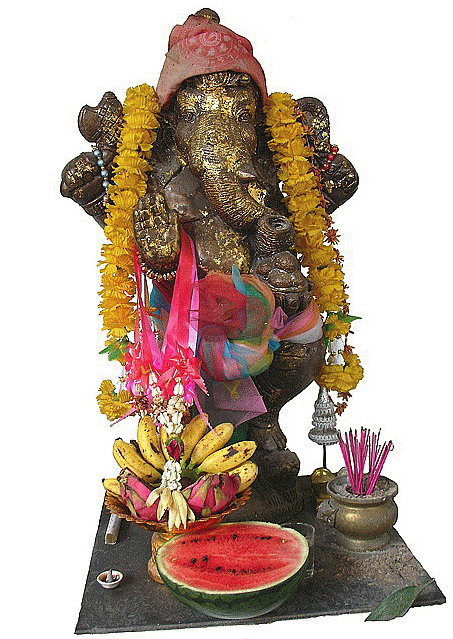
Ritual gifts of food, water, flowers and incense are offered up at shrines and spirit houses everyday all over the country, and if a prayer is answered, the supplicant leaves in return a tiny ceramic elephant, horse, dancing girl, or some other useful object as a gift for the spirit who has obliged. In the shrine above you can see a large hand-rolled cigarette, a small bowl with a pellet of fragrant incense, a betel leaf, and a seven tiered umbrella which is not only a sign of great respect but very useful in such a hot climate. The forehead, trunk, belly and hands of the god have also been rubbed with bits of gold leaf by grateful devotees.
Homprang spends the first hour of each day preparing food and ritual offerings for our altars and spirit houses, and at the end of each day what's left is carefully gathered together to make a feast for our chickens and dogs -- or even for the children if there's something left over really soft and sweet.
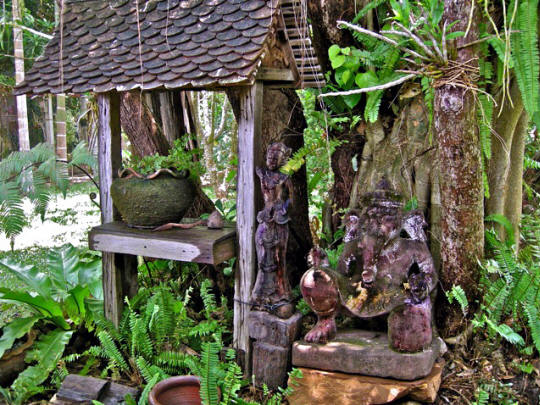
The ceramic water pot at our gate is porous, so it's green with moss and always damp and cool. It is also in the shadow of a large Bo Tree which is covered with ferns and wild orchids A beautiful nang faa carved in teak leans against one of the posts while Lord Ganesha kneels beside her on very sturdy, very human legs. He holds a mortar in his left hand and a pestle in his right in order to prepare herbal medicines for sufferers. The pestle is, in fact, Ganesha's broken right tusk which he willingly sacrifices for our well-being. And of course he writes with it too, helpful words, needless to say -- for openness, generosity and encouragement are his gifts.
;
MONSOON WATER
The gracious draught in the cleft shell,
the cool reprieve, support, belief
dipped from an old clay pot
held out at noon
with torn hands
under the corrugate,
that's pure celestial water—
though every western winner knows
the village well is far more controversial,
the undressed orchid's
purple parts and linen
more dramatically confessed
and soapy moss around the edges
positively pubic.
I wai.
I drink the lot.
Even the sweaty jewels of last night's
frog-storm chorus
cling to the moist hope
that living
may be worth
the heart-breaking thirst
that's sure enough
to follow.
published in RUNES: A Review of Poetry(2004)
___________________
A cool drink of water is offered to the visitor at every Thai portal and doorway, however exalted or humble it may be -- from a crystal glass on a silver tray at the palace or corporate office in Bangkok to a coconut-shell scoop from a moss covered pot in the village.
The 'wai' is the quintessential Thai greeting in which the palms are placed together at chin level, fingertips pointing upward. The gesture denotes respect, gratitude and prayer -- the only universal human gesture close to it is the hands raised high up over the head with the palms wide apart, indicating surrender.
:
A NEW BIO
CHRISTOPHER WOODMAN was born in New York City in 1939. He was educated as an undergraduate at Columbia College, a Woodrow Wilson Fellow at Yale, and a Kellett Fellow at King's College, Cambridge, where his dissertation, "Polyphonic Narrative in Elizabethan Literature," was initially supervised by C.S.Lewis. Along the way he won a Research Fellowship at Christ's College, Cambridge, and was Chairman of the Cambridge University Buddhist Society where he was instrumental in helping the young Lama, Trungpa Rimpoche, become its President. The two were exactly the same age - 26.
Following an unhappy sojourn with Trungpa in Eskdalemuir, Scotland, Christopher returned to England as a single parent in 1970 and taught at Michael Hall, the wonderful Waldorf school his children attended in Sussex. At the same time he renovated a 32ft Norfolk cutter in New Haven and in 1979 sailed away with all 3 of them on board. After a 2 1/2 year, 3 continent voyage he sailed into New York harbor, and in 1982 became Head of the English Department at the Brooklyn Polytechnic Preparatory School in Bayridge with a mandate to rebuild it -- one of the most rewarding as well as challenging experiences of his life. At the same time he began building a new larger sailboat in France and at the same time to write poetry. He published his first poems in Paris in the early '90s while working for France Telecom in the winters and sailing from the Hebrides to the Cyclades in the summers.
That stage of his life came to an abrupt halt in 1994 when his paraplegic older brother Tony was hit by a pickup truck in his wheelchair in Northern Thailand. He abandoned his boat, married Homprang Chaleekanha, a Thai Herbal Doctor, and built a house in a rice paddy where the two of them cared for Tony until his death in 2006. During that time Christopher also taught at Chiang Mai University while at the same time helping Homprang develop a Traditional Medicine School in the same house, and the two of them live and work there to this day.
Having defined himself as a poet on the Seine at 50, Christopher now finds himself at 86 with three unpublished books of poetry on the banks of the Mae Ping. His dream is that one of those books may yet bring him home to share what he has been doing with people who speak his language and love to read and talk about poetry.
Although Christopher Woodman has never been in a writing workshop, worked with an editor, and has never stood up at a poetry in his life, his poems have been accepted for publication by some of the finest journals in America including The Atlanta Review, The Beloit Poetry Journal, The Chariton Review, The Cumberland Poetry Review, The Kenyon Review, and RUNES, A Review of Poetry, and in the end one of his most unlikely as well as most erotic poems was nominated for a Pushcart Prize as the best of the year at the BPJ! *
Christopher Woodman's most recent book, FIG LEAF SUTRAS, a Memoir in Poems, 1995-2025, is built around poetry that anyone can understand about subjects that nobody understands. In addition, he has completed two other very different books, GALILEO'S SECRET, Two Decades of Poems Under House Arrest, and LA-CROIX-MA-FILLE: Hexes, Ruins, Riddles & Relics.
A number of the poems in all three books have been published over the years, and the books have been recognized as well in a number of national competitions, none of his books has yet been published. Needless to say he is still working hard to make that happen.
The following poem, his last to be published, is from GALILEO'S SECRET.
:
* HE MISTAKES HER KINGDOM FOR A HORSE
He heard horses
when she meant writing,
he heard sweat,
the creamy lather where
the taut skin
works against the leather.
He heard writing
when she meant
riding her journal,
the words a broad back
beneath her, pressed
up and caught between
her long phrases and the
need to be heard by him,
the naked verb,
the taut joy ridden
but prepositional,
the taut thorn,
a word, a horse
working between them.
Poem published in THE BELOIT POETRY JOURNAL: A Review of Poetry (2009),
and nominated for a Pushcart Prize in 2010.
It is a key poem in GALILEO'S SECRET.
:
Among Christopher Woodman's very first poems, WATER WORDS was written in his beloved basement
in Carroll Gardens, Brooklyn, just as he was getting ready to leave it forever. The garden was at eye-level.
WATER WORDS
True water words
are sufficient
like a single bed.
They do not lie awake
like visitations
in a crowded night
but rise and fall lightly,
knees drawn up,
arms loosely full of
just length and breadth.
And if they do not wake
they do not worry what
they might have done
the night before,
of if they'd said enough,
or might be understood
as having really
meant something
not like that at all.
Trust in water
words white
and buoyant like
an iron hospice bed
and do not fear
to live or hope
beyond the soft
morning light
or soft voices
of the chidren
in the park.
Published in FIRE READINGS: A Collection of Contemporary Writing from the Shakespeare & Co. Fire Benefit (Paris 1991). In collaboration with Eric Mottram and with a Foreward by Lawrence Ferlinghetti.
As one of Christopher's very earliest poems chronologically, "Water Words" is placed at the very end of FIG LEAF SUTRAS, A Memoir in Poems, 1995-2025.
Conversely, as among the earliest of his poems written in Chiang Mai,"My Frangipani Tree" is placed at the very beginning of FIG LEAF SUTRAS.
:
CLICK HERE to see an example of Christopher Woodman's more ambitious work,
a long poem from LA CROIX MA FILLE: Hexes, Ruins, Riddles & Relics.
|